
 Part of an ongoing campaign to celebrate the wonders of education and professional development.
This is a wrap up of aterrific workshop hosted by SFU’s Writing and Communication Program, led by graphic designer and good-natured print production wizard Gary Schilling.
The course aimed to provide a broad view of design and print production processes. It was a superb reintroduction to professional design approaches; creative techniques; design and print history; functionality and usability; and the management of production processes.
10 Things I Learned About Design and Print Production
1. The Guttenberg Press was invented in 1450. The first daily newspaper was published in 1650. Life magazine first published in 1909. Helvetica was created in 1957. Facts.
2. Proper Lithography started rolling towards the 1900s. Press operators would sit at their machines, with steaming buckets of molten lead at their feet. They had to be ready to fill up the new printing plates on the fly, with the lead. After printing an item, they dumped the letters back in the bucket for reuse.
3. Ligatures are the small joints joining two or more characters into a single typographical unit. They are a typographic refinement, helping certain, poorly set, letters look better when combined. Examples include: ff, fi, fl, ffi, ffl. It is a typographical sin not to use litagtures.
4. Widows are words that sit alone on a line at the end of a paragraph. An orphan is the last line of a paragraph that sits alone at the top of a column or pages. Type does not like to be alone.
5. Renowned Canadian designer and artist Bruce Mau hires untrained non-designers to support his studio at times, believing that the outside perspective is incredibly valuable to informing innovate solutions to design problems.
6. Good planning is essential to everything, including design. Reverse Time-lining is a practical, yet underused, approach to managing production workflows by systematically starting from the projected end point of a project, and working backwards to formulate a workable schedule. Even with this approach, it is admittedly noted that it is quite possible to work backwards and still find yourself behind schedule before you even start.
7. Paper has grain direction. Grain long, or grain short. This refers to the direction the fibers are aligned as they lay across a sheet of paper. When moistened, paper curls parallel to the width expanding fibers, and thus parallel to the grain direction. Print production can be affected by this, because certain registers will only print safely within certain grain directions, and projects that require specialized folding will undoubtedly be at the mercy of the stiff grain.
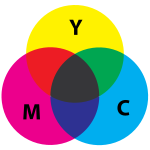
8. The K in CMYK, stands for black (key). Duh! Key (Black) is the fourth ink used in the subtractive colour model for printing. I probably should have know this, but couldn’t remember it at all.
9. Good design makes the strange familiar; it is like a smile in the mind. That’s a quote.
10. Fonts can be funny. What would we do without comic sans.
 we are communicating